
Wayne Selcher1
1 de maio de 2026
Em parceria com o Observatório Político dos Estados Unidos (OPEU), o Boletim Lua Nova republica, em duas partes, a análise do professor Wayne Selcher, de Elizabethtown College, Estados Unidos, sobre sobre as fontes de análise de mídias estadunidenses e as notícias políticas. Este texto é o primeiro de uma série para o OPEU sobre as notícias políticas nos Estados Unidos. O texto foi originalmente publicado em 22 de abril de 2026, no site do OPEU.
Leia a primeira parte aqui.
***
Key Resources for Non-Partisan Analysis, Data, and Investigative Journalism
General Political Analysis
Semafor has a global presence and calls itself “the world’s first news platform designed to meet the moment we are in.” The news and analysis coverage in its email briefings is first-rate and very highly recommended, particularly in Semafor Washington, DC and Americana. Topical sections include Media, Politics, Business, and Security.
The Annenberg Public Policy Center, of the University of Pennsylvania, provides data and analysis on the role of communication and media in politics, among other topics, such as high-quality classroom materials and civics education.
The Hill is a widely cited publication, influential in Washington, that “serves to connect the players, define the issues and engage Washington’s decision makers in the debate.”
The Conversation delivers “academic rigor, journalistic flair” in a wide range of topics, including U.S. politics, government, and society — “trustworthy and informative articles written by academic experts for the general public and edited by our team of journalists.”
PsyPost, while focusing on the broad scope of psychology, posts summary results of academic studies on political psychology as it affects U.S. politics, with links to the original articles. A newsletter allows you to follow recent additions.
POLITICO is a major news operation widely used by U.S. academics, public administrators, and businesspersons because of its non-partisan style and depth and breadth of reporting on political actors, events, policies, and trends. Playbook is well worth your attention: “The unofficial guide to official Washington, every morning and weekday afternoons.” A paid POLITICO Pro option is available for more complete coverage.
Real Clear Politics is very useful for scholars because it covers a wide range of news and views across the political spectrum, “to present our audience with informed viewpoints spanning the ideological spectrum in ways that help facilitate meaningful discourse on governance, campaigns, elections, and public policy.”
ProPublica is a widely cited “independent, non-profit newsroom that produces investigative journalism in the public interest… shining a light on abuses of power and betrayals of public trust.”
Axios works under a pledge of political neutrality and serves up reliable and often-short form news and analysis for politics and several key fields of business. They offer many free newsletters tailored to those audiences, as well as a paid Pro version for several industries.
SCOTUS Blog is a commonly referenced authority for information and analysis about the U.S. Supreme Court and the federal courts, with weekly newsletters.
The Supreme Court Database, from Washington University Law School, describes itself as “the definitive source for researchers, students, journalists, and citizens interested in the U.S. Supreme Court. The Database contains over two hundred pieces of information about each case decided by the Court between the 1791 and 2024 terms.” The site includes a comprehensive user’s guide and code books for the data.
Courthouse News Service will be valuable for those who track legal issues and trends in the United States, with its “focus on the law, cases, major rulings, trials, arguments and opinions within the state and federal courts.”
The Brennan Center for Justice is a highly regarded independent institution at the New York University School of Law and posts insightful analysis of current and general legal issues in politics and government, with suggested solutions.
Roll Call, “the premier source of timely news, objective facts and analysis, and coverage of elections and the politics of legislation,” covers Congress closely and is widely used by those in Washington who need to know the facts, trends, and dynamics in the national capital.
Silver Bulletin, by Nate Silver, formerly at the Washington Post’s 538, offers quality “essays and analysis about elections, media, sports, poker, and all the other things I care about.” His Poll of Polls charts represent an average of many public opinion polls on a topic or politician, not just a single poll.
USA Facts provides reliable data and facts-based information about the United States from standard sources, including in its political and governmental aspects, often presented through graphs and charts.
Statista is a source of trustworthy cost-free statistics on many aspects of the United States, as well as on many countries and industries, although full access requires a paid subscription.
The Archive of Political Emails “collects emails from political candidates, elected officials, PACs, non-profits, NGOs and others shaping the political debate.”
Lawfare Media is a “non-profit multimedia publication dedicated to ‘Hard National Security Choices.’ We provide non-partisan, timely analysis of thorny legal and policy issues through our written, audio, and other content… areas of coverage range from national security law, threats to democracy, cybersecurity, executive powers, content moderation, domestic extremism, and foreign policy, among many others.”
The American Presidency Project at the University of California at Santa Barbara provides free and searchable access to their very large archive of documents from and about the American presidency, striving to be “recognized as the authoritative, non-partisan on-line source for presidential public documents.” Orientation to the database and best search methods is provided for users.
The Budget Lab at Yale University is an extensively-cited “non-partisan policy research center dedicated to providing in-depth analysis of federal policy proposals for the American economy… particularly focusing on the long-term effects of proposed policies on the economy, the income distribution, and recipients.”
Intrigue Media offers thoughtful and objective analysis of issues in American foreign policy and global affairs generally, including with a free newsletter.
Elections, Campaigns, and Voting
The Cook Political Report, highly recommended, is “an independent, non-partisan newsletter that analyzes elections and campaigns for the US House of Representatives, US Senate, Governors and President as well as American political trends.”
Sabato’s Crystal Ball, from the University of Virginia, is a very useful scholarly reference source to follow “presidential elections, along with every race for the U.S. Senate, House of Representatives, and state governor,” as well as “analysis of trends in American politics and elections.”
Ballotpedia, extensively used, posts a wide range of “unbiased information to educate and inspire American voters.” Particularly helpful for electoral statistics and big picture trends.
The U.S. Elections Atlas provides “results of U.S. Presidential Elections to the world community. Data is collected from many official sources and presented here in one convenient location.” Congressional and gubernatorial election results are also included, and “high-level data and maps (state, national) as well as the county and congressional-district maps” are free. Paid membership provides access to much more detailed data.
The University of Florida Election Lab, composed of a team at that university, provides various forms of data on U.S. elections at all levels down to the precincts.
Other reliable sources for U.S. election information and statistics include the MIT Election Lab, Vote Hub, American National Election Studies, and The Downballot Ultimate Data Guide.
Public Opinion Polling
Gallup is a very well-regarded polling organization, providing abundant survey data and analysis on a wide range of U.S. public opinion and attitude topics. They are one of the best organizations for information about U.S. public opinion on American foreign policy and international matters. The free Front Page newsletter and release alerts will keep you up to date on their products.
Pew Research is excellent for reliable public opinion and attitude surveys, with thoughtful analysis, on a very wide range of topics. They have a dedicated News Habits and Media section, among many others. Their latest Religious Landscape Study (2025) surveyed “more than 35,000 Americans in all 50 states about their religious affiliations, beliefs and practices along with their social and political views and demographic characteristics.” Sign up for the free weekly The Briefing newsletter, a data-based summary “that rounds up what’s happened and what’s coming in the news and information world.” Other newsletters are available as well.
Morning Consult posts data-based reports using “high-frequency political polling data to provide vital insights on U.S. political news with topics such as election tracking, hot-button culture war issues, congressional politics, leader approval ratings and much more.” It offers free summaries, but paid subscription is required for full access to data and in-depth reports.
The AP-NORC Center is a public opinion polling-focused partnership between the Associated Press and the University of Chicago that “taps into the power of social science research and the highest-quality journalism to bring key information to people across the nation and throughout the world,” covering a wide range of topics.
The Chicago Council on Global Affairs conducts public opinion polls on issues in American foreign policy, as well as posting its own analyses.
YouGov (“an international online research data and analytics technology group“) is a frequently referenced polling organization, covering a broad range of topics of interest in American society. Note their handy newsletter, The Surveyor.
Ipsos is “one of the world’s leading market research companies,” and publishes many reliable polls and reports on American politics and society.
The Reuters Polling Explorer provides ongoing data on a wide variety of topics, as “an interactive tool featuring over 18 months of Ipsos/Reuters polling data and counting. Based on 200,000+ interviews, data collection began in January 2012 and continuously polls between 2,000 and 3,000 people a week.”
The Roper iPoll, from the Roper Center at Cornell University, is a search facility to find polling questions and datasets from the Roper Poll’s huge databank.
The monthly Harvard CAPS-Harris Poll is an excellent ongoing source on the mood of the American public, as is the annual Harvard Youth Poll, for that segment of the population.
FiftyPlusOne “is a website devoted to political polling and elections. We gather every poll released in the U.S., process the data into intuitive and insightful interactive journalism, and make the data available to researchers, journalists, and anyone else that uses polling data in their businesses.” Some data available cost-free.
Populace sponsors “private opinion” surveys with a distinctive methodology using a “new science of individuality that provides us with an unprecedented understanding of individuals on their own terms.” Anonymous, individualized, in-depth responses “designed to protect privacy and reduce social desirability bias” provide insights into the public’s actual views on key social issues in extensive reports from 2022, 2024, 2025, and beyond.
Voice of the People, a non-partisan organization in partnership with the University of Maryland, maps out and publishes survey-based reports on the “more than 250 policy positions on a wide range of issues supported by majorities of both Republicans & Democrats.”
Bright Line Watch, a multi-university organization, tracks the health of American democracy over time through surveys of American political scientists, “to monitor democratic practices, their resilience, and potential threats.” Site features ongoing graphs and analysis of survey results since 2017, with resultant ratings by experts and the public, including results by political party.
For those interested in the major role of religion and faith in American society and politics, an indispensable option is the Public Religion Research Institute, “a nonprofit, nonpartisan organization dedicated to conducting independent research and driving conversations at the intersection of religion, culture, and politics.” PRRI posts many extensively-used and meticulous polls and reports, including on Christian nationalism. Outstanding survey-based products include the Census of American Religion and the American Values Survey. A free news alert signup keeps you informed of their latest releases.
It should be noted that Real Clear Politics, although not a polling organization, compiles and averages the results of many public opinion polls, with an archive, so you can “gain valuable insights into the evolving political landscape and stay ahead of the latest trends.”
Tracking State and Local Governments: Specialized News and Analysis Tools
Specialized search facilities are available to those who wish to follow state, local, and community news, including official business and issues of federalism, as it originates directly from those places instead of through the national media. A lot occurs in state and local governments, and surveys show consistently that Americans trust their local news outlets far more than the national ones. Yet, as an October 2025 Northwestern University annual report on the State of Local News documents, truly local news is struggling, as more local newspapers close and “the number of news desert counties – areas that lack consistent local reporting – has grown steadily.”
Governing magazine is directed toward public administrators but is a practical guide for keeping up with state, local, and federalism issues.
U.S. Local Media by County, from William & Mary University, “displays an interactive map showing a collection of newspapers, TV broadcasts, and radio stations on a per-county level,” with links to the media. Useful for those who want to see how local news media around the country are covering a story, since over 14,000 media sources are indexed and accessible, including their social media presence. A worldwide version is also offered.
Local Search America allows you to “discover, analyze, and monitor local information across America with our suite of three research tools. From breaking news to local government, from universities to your town’s TV stations – discover American communities in a different way.”
Find Your News is a search facility focusing on community-level, nonprofit, independent newsrooms “that are producing fact-based, public service journalism.”
States Newsroom is “the nation’s largest state-focused nonprofit news organization, with reporting from every capital.” Includes Stateline, which covers “the big challenges and policy trends that cross state borders” and News from the States.
Bolts “covers the nuts and bolts of power and political change, from the local up… the places, people, and policies that shape public policy,” focusing on local and state issues and elections, power centers, and especially on “criminal justice and policing, and voting rights and democracy.”
Google News and Bing News allow users to set location preferences, thus accessing news from that local area. Calishat, an online search expert, provides some tips on how to access this information.
Key Political News and Information Sources Across the American Ideological Spectrum
Purevpn offers a clearly-presented listing, description, and tabular analysis of the 13 Most Unbiased News Sources to Read in 2026, those with “minimal opinion,” along with other major ones that exhibit consistent partisanship or ideological tendencies, thus covering the spectrum of “centrist, left-wing, and right-wing sources.” For a more detailed inventory across the board, the public relations firm PR Lab lists and describes the 100 Top Media Outlets for News Coverage in 2025, “chosen for credibility, pickup potential, and real-world impact.”
Several worthy centrist sites are not mentioned in either of these surveys. 1440’s daily newsletter is widely regarded as a facts-based reporting option, producing brief curated summaries and explainers without opinion slants, a role that its CEO called being the “connective tissue in the industry.” News Nation tends to cover the spectrum, while Breaking Points is a recent independent centrist video enterprise. Punchbowl News is excellent for its reliable coverage of the Washington power structure, especially the Congress, with the motto “Power, People, Politics.” Tangle provides a broad selection of news and information, with views, opinions, and summaries from across the political spectrum, plus the site’s own thoughtful perspectives. NOTUS (News of the United States) is based in Washington, D.C., and covers government and politics, including campaigns and elections, in the capital and throughout the U.S., with a Perspectives section “for analysis, ideas and narratives.” NOTUS has hired numerous quality journalists who left the Washington Post after its severe decline.
Republicans and Democrats follow and base their intra-party conversations on, within, and about very different information sources, resulting in quite distinct internal and public dialogues about what matters and what is happening. This sharp partisan contrast in points of reference is seen even at the level of mentions of dissimilar online sources in official Congressional newsletters to constituents. As Professor Lindsey Cormack has noted, “Congressional Republicans are very good at communications, not only in how they stay on message and devise catchy terms, but also in how they make use of ‘owned’ media outlets far more often Democrats.” Democratic politicians have been weak in their social media presence relative to Republicans, especially regarding strategy, messaging (form and content), and engagement with constituents.
As of early 2026, the Right is more dynamic and effective online, with energy buoyed by a sense of being on a winning streak in the successful offensive against the “liberal managerial state,” “wokeness,” and the social groups that created and support them. Beyond the many blogs of Republican politicians, there is a huge number of podcasters on the Right, for example, many of whom have a highly devoted following.
The Left is still trying to reorganize and redefine itself after the major defeat of its message at the polls in November 2024 and Trump’s radical reform campaign that has followed. However, certain voices on the Left, concerned about autocracy and the health of democracy in the face of Trump’s attacks on critical media and higher education, have rallied, are boosting different media platforms (such as Courier), and produce some interesting insights that may form the basis for the future of progressivism.
The numerous examples from both camps, cited below, mix many types of sources and platforms for delivery, which is the typical situation faced by an American who seeks out diverse points of view in the changing media landscape. Most seriously competitive influencers appear on multiple platforms, to maximize their outreach to a variety of devices and viewer preferences. Traditional media (newspapers, television, radio, magazines) mixes with alternative media (podcasts, blogs, news websites), as well as the production of think tanks.
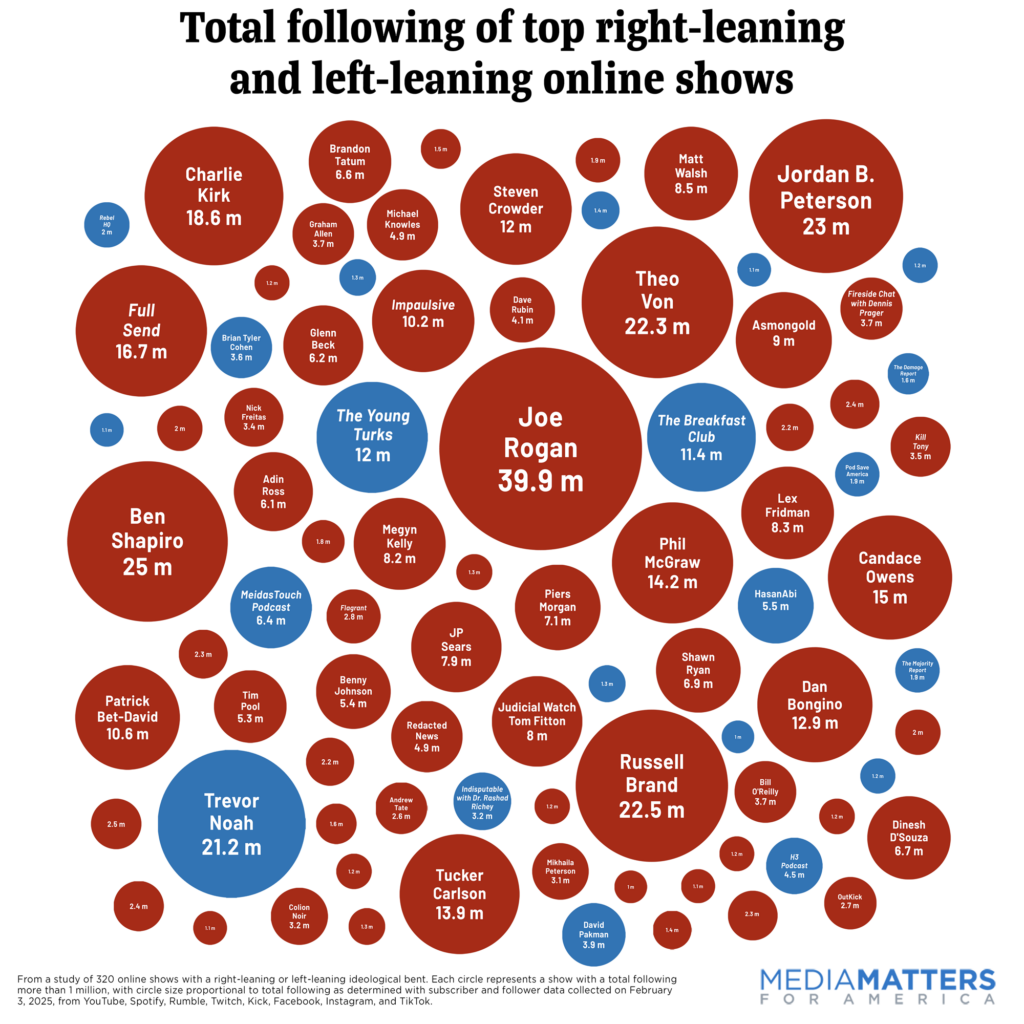
Source: Media Matters for America
The Conservative and Right-Wing Media Ecosystem and Trump’s Digital Presence
TheRighting is “geared mainly for mainstreamers and progressives who are interested in the viewpoints of right-wing media.” It aggregates material from many right-wing outlets (over a dozen headlines daily) and produces some original news reports, along with a newsletter and reports about the usership of conservative news outlets, including podcasts. Also posted are the top 20 right-wing websites by audience size (monthly), right-wing site traffic reports, reports on podcasts, and notes about which sites Trump links to in his posts. There are guides to right wing media, conservative media personalities, the liberal media, and right-wing outlets that have ceased publication since 2018. This work is beneficial for anyone who wants to learn about and peruse the growing body and popularity of online American conservative media. At the moment, there is no equivalent news and analysis aggregation website tracking liberal media.
Axios provides a MAGA media map, current as of November 2024, and featuring those who are “younger, more visual, less established in Washington, and lean more toward MAGA conservative principles over traditional Republican ideals.” Thoughtco.com lists and describes the Top 10 Conservative Educational and Advocacy Web Sites as of May 2025. Rumble and Gettr are major and popular locations and aggregators for conservative and right-wing political videos that the media-savvy academic should be aware of.
Influence Watch, from the conservative Capital Research Center, furnishes reliable and detailed public “information on over 15,000 public policy influencers on demand,” as thorough profiles of political actors (individuals, organizations, and institutions), social movements, funding sources, and policies.
President Donald Trump makes very frequent and hyperbolic use of all forms of social media, and especially of his own Truth Social platform and the X platform, including to announce important decisions, ultimatums, policy swings, and the achievements of his administration. His fans follow him closely and love his brash, confrontational, norm-defying, and ranting style, including the many satirical AI videos and fake images portraying him as a hero, in a provocative practice called “trolling,” to attack and anger his opponents. This tactic plays well to the growing trend toward politics as superficial performance and entertainment, that features ridicule, emotion, and sensationalism that devalue serious thought about policies and their effects. Many of his statements are of dubious veracity and insulting in tone and are often designed to attack critics in petty and personal terms and to justify his unconventional actions. Trump’s use of social media in this populist and personalistic fashion has succeeded in re-defining presidential messaging toward a style that would have been considered by most of the public as outrageous and degrading of the office a decade earlier.
Archives of his postings are found at Trump’s Truth and Roll Call. The Trump Media firm is majority-owned by the Donald J. Trump Revocable Trust and was formed in February 2021, after he was barred from major social media platforms following the January 6 attack on the U.S. Capitol by his supporters. Its slogan is “our mission is to end Big Tech’s assault on free speech by opening up the Internet and giving people their voices back.” It administers Truth Social and a Truth+ streaming service (“Make TV Great Again”) on several platforms, as a “home to pro-freedom news networks like Newsmax, Real America’s Voice, OAN, and more—as well as a large library of top-tier non-woke TV shows and movies.”
The White House maintains an unprecedented wall-to-wall and assertive online presence on all possible platforms, continually and rapidly updated as events unfold. Democratic statements and actions are swiftly rebutted, often with a largely-visual social media storm of doubtful claims and allegations. The White House communications staff skillfully attempts to dominate the news cycle (through agenda setting) and to distract attention from inconvenient topics. The major conservative and alternative outlets, including some individual MAGA influencers, have full press credential status at briefings, in contrast to the more liberal lineup under former President Joe Biden. Nor, under Biden, were certain journalists barred, humiliated, and prohibited from asking questions or entering public buildings, as is the case with the Pentagon under Secretary of Defense Hegseth. The White House Wire presents news from the perspective of the administration. An official mobile news app is available for instant notifications, termed “unparalleled access” to the administration. Official social media account contents from his first term are archived online at the Donald J. Trump Presidential Library.
Conservative and Right-Wing Sources for News and Commentary
The Right is known for counter-elite messages that challenge and refute the narrative that was dominant until recently, but it is not homogenous, as was made clear by disagreements among key speakers within MAGA during the Turning Point USA’s AmericaFest convention in December 2025. Commonly used and referenced sources in the conversation within the Right include these:
Liberal and Left-Wing Sources for News and Commentary
Much of the long-established mainstream press is widely seen as tilting toward the liberal side, but the Left is not homogenous, as is quite evident in the Democratic Party’s turmoil during the second Trump administration. Other commonly used and referenced sources in the conversation within the Left include these:
Quality Video Newscasts and Documentaries for Political and Policy Research
Among the millions of videos on YouTube are some valuable news sites and documentaries about American politics, economics, and foreign policy. One must select carefully, because the vast majority of the popular videos on this platform are posted for entertainment purposes rather than serious academic use, with a growing admixture of AI-generated content. Some of the AI videos are designed to give the false appearance of being legitimate news sources or interviews. The tech blog UMA Technology offers a thoughtful guide on how to judge the credibility and reliability of YouTube political channels, for critical thinking and analytical skills. As a general rule, personality-driven channels by single individuals tend to advocate a consistent ideological point of view and some emotionally laden content to promote viewer ratings. For ongoing academic relevance, prefer noteworthy professional organization sources, such as the YouTube channels of the PBS Newshour, Fox News, CNN, NBC News, CBS News, the Associated Press, and Bloomberg Television. As mentioned earlier, BBC News , Deutsche Welle News, and Al Jazeera English are some trustworthy foreign media outlets that offer some perspectives from outside the U.S.
Documentaries by reliable organizations are particularly worthwhile, such as the Public Broadcasting System’s long-running Frontline series and its American Experience series. Also excellent on YouTube are the award-winning PBS documentaries on American history by Ken Burns, such as The American Revolution. Of particular current interest is the 2025 Frontline series documenting Donald Trump’s return to the presidency and his subsequent rapid expansion of the power of that office, with significant resistance from the court system, featuring interviews of Trump allies, opponents, and expert analysts. Ten extended interviews of these persons are available as separate videos.
Another recent documentary to consider is “Bodyguard of Lies” (2025), which “exposes how U.S. officials wove a complex web of deception during the 20-year war in Afghanistan.” (Pay-to-view, on Paramount Plus)
Quality Blogs of Academic Research Interest
Quality blogs are worthwhile places for ideas and data to spark, inform, or direct your research. Many are written by university professors and thoughtful political commentators. The two main platforms useful to academics are Substack and Bluesky, but Instagram, X, Spotify, and YouTube are also commonly used. Many of the thousands of blogs today are ephemeral, but those below should be around for a while. Most of these writers are on several different platforms, often with different content, so keep that in mind as you browse.
Adam Bonica, Professor of Political Science at Stanford, on “money in politics, campaigns and elections, ideology, the courts, and inequality”
Civic Tracker “Follow presidential actions, Supreme Court decisions, and social media — all in real time”
The Good in Us By Mary L. Trump, President Trump’s niece and a clinical psychologist
On Data and Democracy “Data-driven insights illuminating the challenges and potential paths forward for American democracy”
Drezner’s World “About international relations, American politics, political economy, the marketplace of ideas, and popular culture”
The Status Kuo “Accessible political and legal analysis with a dose of humor”
Public Notice “Independent, incisive coverage of US politics and media”
Graphs about Religion (Ryan Burge) Notes about religion and social change in the U. S. from a Washington University professor
Strength in Numbers “Independent, data-driven analysis of politics, public opinion, and elections”
Tusk “Understanding U.S. political parties, who they nominate, how, and why”
Robert Reich “Daily newsletter exposing where power lies — and how it’s used and abused”
Paul Krugman Observations on economics from a professor, Nobel laureate, and former columnist, NY Times
Blue Blaze “International relations and US foreign policy, off the main trail”
Democracy Index “Unflinching journalism in defense of democracy”
Civil Discourse “The legal knowledge & analysis you need to be an advocate for democracy”
Letters from an American “A newsletter about the history behind today’s politics”
Good Authority “Political scientists draw on their expertise and the discipline’s research to provide in-depth analysis, illuminate the news, and inform the political conversation”
Good Politics/Bad Politics “Newsletter about government and elections in the US”
Jay Van Bavel Insights from a Professor of Psychology and Director of NYU Center for Conflict & Cooperation
One First Aims “to make the Supreme Court’s rulings, procedures, and history more accessible to all”
Law Dork “The Supreme Court, law, politics, and more”
Lawrence Lessig Thoughts on law, ethics, and democracy from a leading professor at Harvard Law School
Leah Litman Constitutional law issues examined by a University of Michigan School of Law professor
Liberal Currents “Writers of diverse perspectives who share an unflinching commitment to freedom, pluralism, and democracy”
Conrad Hackett From a demographer at Pew Research, on social and political matters
The Steady State By “veterans of the U.S. National Security Community concerned about the future of our nation”
Crash Course with Casey Burgat “The civics class we never got, but desperately need”
The Watch “Reporting and commentary on civil liberties and the criminal justice system”
Kosar on Congress and Governance “My takes on Congress and governance”
Steve’s Notes on Congressional Politics “Insightful briefs on the politics of the U.S. Congress”
Polls and Votes “Polls in Perspective, Votes in Context”
Can We Still Govern? “Can modern states, and the US state in particular, still govern amidst an increasingly fractured public and anti-democratic tendencies?”
DCinbox Insights “Tracks how members of Congress communicate with constituents by highlighting what’s emphasized, what’s shifting, and what those changes reveal about emerging political narratives”
The Liberal Patriot “Political and policy analysis from the vital center”
The Ezra Klein Show “Real conversations. Ideas that matter. So many book recommendations”
The David Pakman Show “One of the most watched independent progressive programs in the country”
The Rachel Maddow Show From one of the contemporary icons of the American Left
US Politics: a Brazilian Lens “News, analysis, and insights through a Brazilian Americanist’s perspective”
Several Audio Podcasts of Academic Interest
| The Politics Lab Not Another Politics Podcast Left, Right, & Center | The Daily Blast Amicus Understanding Congress | Pod Save America True Anon Politics in Question |
Conclusion
News sources beyond the mainstream and traditional American media operate within the digital fragmentation and ideological polarization of the broad contemporary U.S. information landscape, public distrust of expertise and the media, still-growing partisan division, and questioning of the nation’s basic institutions and values. Pressing future concerns for those academics who depend on the online media for information will include increased misinformation, deliberate deception, challenges to press freedom, online robots, and the rise of AI-driven content and dissemination. Within this setting, the academic researcher should adopt a critical, multi-sourced approach that moves well beyond reliance on the long-traditional gatekeepers of information. The resources profiled here are essential tools for accessing and assessing the range of alternative views and therefore provide a more complete perspective on the broad national discourse in American politics. With careful techniques, researchers can more accurately identify biases, track information and misinformation, and understand the full spectrum of opinion shaping the highly animated national political conversation today.
Future articles of this series will build upon this foundation to sort out the current socio-political context of the political news flow in the United States, major technological and market factors in political news and information production and distribution, the news consumption patterns of the public, and their effects on the evolving political dialogue and on the news industry.
***
Acknowledgements
The author would like to acknowledge the valuable suggestions, feedback, and professional collaboration received on this article and over the recent years from Tatiana Teixeira, PhD, editor of OPEU and media specialist. Those who kindly commented on early drafts include the following three professors of American Government: Fletcher McClellan, PhD and Nathan Gibson, PhD, of the Political Science Department at Elizabethtown College, Pennsylvania, USA, and Hilde Eliassen Restad, PhD, Associate Professor in the Department of Political Science and International Relations of Oslo New University College, Norway. The author would also like to acknowledge the helpful advice offered by longtime colleague Cynthia Watson, PhD, formerly of the National Defense University, in Washington, D.C.
* Este texto não reflete necessariamente as opiniões do Boletim Lua Nova ou do CEDEC. Gosta do nosso trabalho? Apoie o Boletim Lua Nova!
- Wayne A. Selcher, PhD, é professor Emérito de Estudos Internacionais no Departmento de Ciência Política, na Elizabethtown College, PA, USA, e colaborador regular do OPEU. É fundador e editor da WWW Virtual Library: International Affairs Resources, um guia para pesquisa on-line sobre os mais diversos tópicos. Contato: wayneselcher@comcast.net. Revisão e edição final: Tatiana Teixeira. ↩︎