
Harald Stelzer1
5 de agosto de 2026
***
Este escrito compõe a Série Especial do Boletim Lua Nova, em conjunto com pesquisadores e pesquisadoras vinculados à rede internacional Justice in the XXI Century: A Perspective from Latin America (JUSTLA). O projeto, coordenado pela Universidade de Catania (Itália) e financiado pela União Europeia no âmbito da ação HORIZON–Marie Skłodowska-Curie Staff Exchanges, reúne integrantes de instituições da América Latina e da União Europeia.
***
The radio crackles. Your guide sets down his binoculars and turns with a quiet smile. They have found one. Your heart rate doubles.
That moment – somewhere on the windswept Patagonian steppe – is what thousands of people travel to Torres del Paine each year to experience. The national park in southern Chile has become the world’s best-known destination for observing the puma (Puma concolor) in the wild, and the industry built around this encounter is genuinely remarkable. It has changed how ranchers think about predators, brought conservation investment to former sheep farms, and generated a cooperative tracking culture among local guides that is unlike anything I had seen elsewhere. It has also, at times, created some of the most chaotic wildlife encounters I have ever experienced.
I spent eight days in the park, six of them tracking pumas with a professional guide. I came as a philosopher working on biodiversity ethics – not primarily as a wildlife photographer, though I brought the camera. What follows is a personal account, but also a critical one: an attempt to think clearly about what puma tourism in Torres del Paine actually achieves, and what it costs.
A History Built on Economics, Not Ethics
Pumas were systematically hunted across the Patagonian estancias throughout much of the twentieth century. Ranchers regarded them as a threat to sheep and cattle, and culling was standard practice. What changed that attitude was not persuasion or legal enforcement, it was money. A before-and-after study of rancher attitudes near the park found a shift from near-universal support for illegal hunting to majority support for conservation after roughly a decade of tourism development (Ohrens et al., 2021). Living pumas had become worth more than dead ones. Tortato et al. (2020) add an important detail: the collapse of sheep farming in the early 2000s, partly driven by severe weather events, created the economic opening that tourism needed. Conservation filled a vacuum; it did not generate one.
The results are, on the whole, impressive. Estancia Laguna Amarga, formerly a working sheep ranch, is now a 7,000-hectare puma conservation reserve, funded substantially by the tourism it hosts. The genetic health of the Torres del Paine puma population appears stable: a recent genetic assessment found no evidence of inbreeding depression despite the area’s geographic isolation (Elbroch et al., 2024). These are real outcomes, and any honest account of puma tourism has to take them seriously.
But the history also carries warnings. Ohrens et al. (2021) note that the attitude shift is unevenly distributed: ranches bearing the costs of livestock predation while their neighbours capture the tourism income remain a potential source of conflict. No systematic compensation mechanism is in place. The conservation gains rest on a continued alignment of economic interests that is not guaranteed.
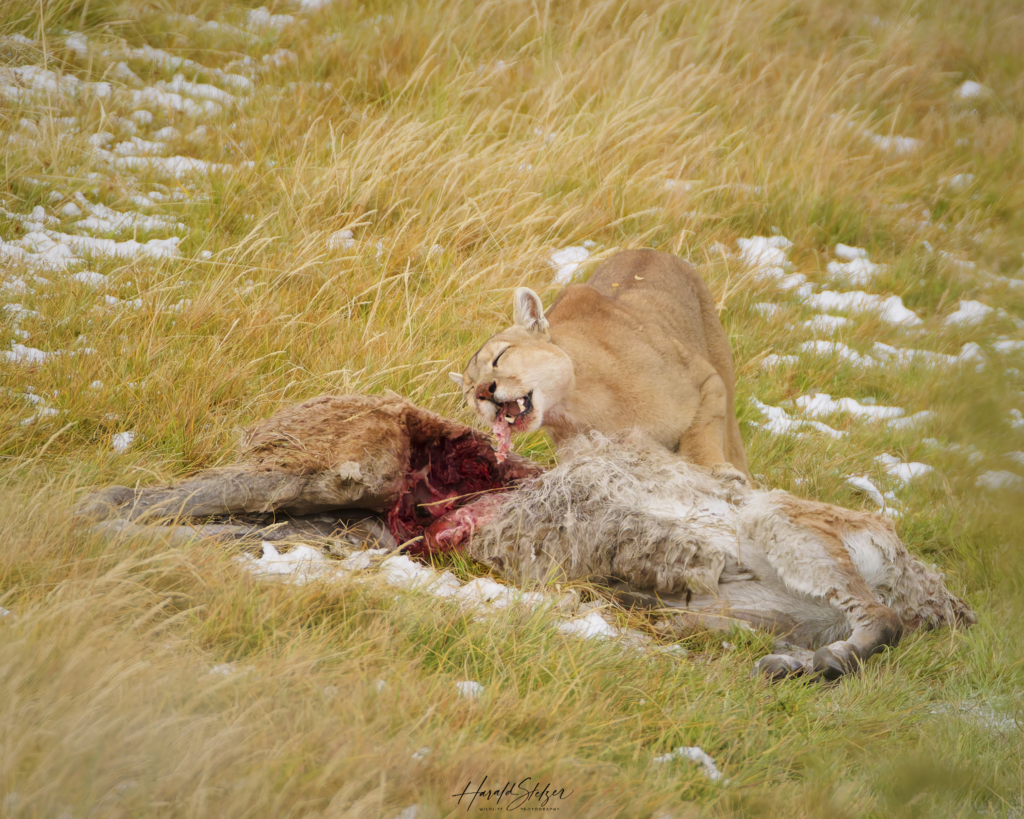
Petaca, the most famous individual puma in Torres del Paine, after walking calmly alongside the road. She has appeared in BBC Dynasties and several other wildlife productions.
How the System Works – a market sharply tiered
On a typical morning in the shoulder season, a dozen or more guide vehicles work the park’s eastern sectors simultaneously. What makes this function without chaos is a cooperative radio network: when one guide locates a puma, or reads signs of nearby activity, the information is shared. Experienced trackers rarely look directly for pumas – they read the landscape’s alarm vocabulary instead. Guanacos that break their grazing rhythm or emit their sharp braying call are almost certainly responding to a predator. Condors circling low may indicate a kill. A culpeo fox moving with unusual purpose may be following a carcass scent. On the private estancias bordering the park, dedicated scouts patrol from first light, feeding real-time intelligence to guides working with visitor groups. The search is genuinely collaborative – exchanging information, reading the landscape, stopping, observing (Chile Nativo, 2026).
Since 2025, the national park authority has formalised a puma observation protocol: assess body language before approaching, avoid blocking movement corridors, withdraw if the animal shows stress. These are good guidelines. Whether they hold in practice is something I will come back to.
The market is sharply tiered. At the cheapest level, anyone with a rental car can drive the eastern road corridors and occasionally, by luck, encounter a puma. No booking, minimal cost, low and unpredictable success. At the middle tier – guided day tours from Puerto Natales, departing before 4 AM, costing roughly USD 300–500 per person – access to the radio network substantially improves the odds, typically to somewhere between seventy and ninety percent on a well-guided day. At the premium tier, multi-day programmes with access to private estancia land – from around USD 5,000 per person – operate under different conditions entirely. Guides can take small groups on foot across the steppe, following habituated individuals at close range. This is where BBC and Netflix production crews have filmed, and where the encounters look like what most visitors imagine when they book their trip (PatagoniaPhoto.com, 2025; Wild Images, 2025; Far South Expeditions, 2025; EcoCamp Patagonia, 2025).
What operators at the middle tier rarely state clearly enough is the hard constraint that defines the experience: guided day tours are confined to public roads and permitted roadside areas. You cannot follow a puma on foot. The animal may be thirty metres away or three hundred, and you have no meaningful control over which.
Six Days on the Road: What I Saw
The dominant pattern of my six days became clear from the first morning. A puma is located by radio, multiple vehicles converge, a queue forms along the road. The animal is observed from a collectively determined distance – set not by the puma’s behaviour or anyone’s skill, but by road geometry and how many other vehicles are present. Our guide was professional and consistently got us a better position than most. But ‘better’ remained relative.
One afternoon I will not forget: we crested a low rise to find a mother puma and her cub beside a fresh guanaco kill near a small lake. Several vehicles were already there; the female had retreated into scrub at the sound of approaching cars. We waited. When the crowd thinned she emerged, walked to her kill, began feeding, and the cub appeared behind her. It was genuinely beautiful. And the photographs I took, with equipment carried across an ocean for this moment, were at the outer limit of what any lens can do at that distance.
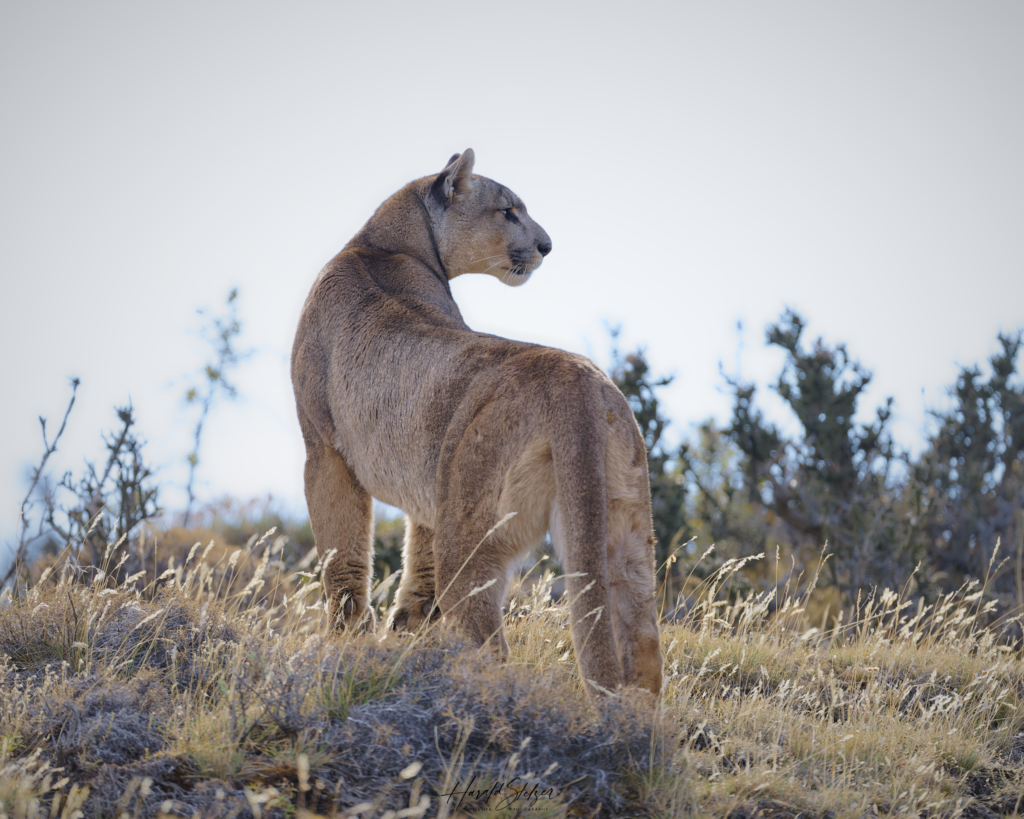
A female puma with here prey, feeding at quite a distance, after waiting for the crowed to depart.
The guide held us back not from ethical principle but from collective action logic: if one person approaches, everyone approaches, and if everyone approaches, the puma leaves. It is a simple rule, but it captures something important about how shared wildlife resources actually work in practice. Individual behaviour is constrained not mainly by personal ethics or experience but by the predictable responses of everyone else.
The most unsettling encounter was near the end of the trip. Coming over a low hill as we left the park after another long unsuccessful morning, we found twenty or so vehicles parked on both sides of the road – buses, private cars, wildlife vans. A bus driver signalled us to stop: a puma was a about to cross. Visitors were already out of their cars and moving toward the crossing point. Guides held the crowd in loose formation on both sides of the road. Then a bus from below refused to stop. The driver moved through the crowd; people stepped aside; and once he passed, the discipline collapsed. Other vehicles started moving. At the end the puma still crossed the road by jumping the guardrails.
The puma, we learned afterward, was Petaca – the most famous individual in Torres del Paine, a matriarch who had appeared in BBC Dynasties and several other productions. She had been attempting to hunt. She gave up and walked away. The encounter felt less like wildlife tourism than a road traffic incident in which a large predator happened to be involved. The bus driver almost certainly was not making a personal decision – he was following a schedule, probably running late, as buses on day trips from Argentina often do. The aggregate of individually defensible decisions added up to a disrupted hunt.
The next day we encountered Petaca again. Smaller group, quieter, mostly photographers who knew the etiquette. The guides held everyone in place. She lay down on an embankment, descended to drink, and then walked two hundred metres along the road verge while photographers moved quietly alongside her. She seemed unhurried. The encounter was simply beautiful. What separated the two days was not the puma or the terrain. It was whether the people present were willing to be still.
What Tourism Achieves – and What It Leaves Unresolved
The case for puma tourism is real. The conservation outcomes, documented attitude change, economic conversion of conflict land, a healthy population, are not trivial. In most of the puma’s range, livestock conflict remains the primary driver of persecution. The Torres del Paine model has, imperfectly and unevenly, demonstrated that coexistence is possible when living predators have financial value.
What is harder to assess is the welfare of individual animals under sustained tourist pressure. Guzmán-Aguayo et al. (2025) provide the first data on spatiotemporal overlap between tourists and pumas in the region, based on twenty months of camera trap monitoring in Patagonia National Park. Their finding of predominantly nocturnal puma activity is somewhat reassuring, but the study area is less intensively visited than the Torres del Paine eastern corridors, where overlap figures are likely higher. There is no systematic physiological stress monitoring for the Torres del Paine population – and that gap matters, because the absence of visible distress is not the same as the absence of harm. Research on Magellanic penguin colonies in the same region has shown chronic stress markers in high-exposure colonies despite surface-level behavioural adaptation (MDPI, 2026). Moorhouse et al. (2015) found that 18 of 24 categories of wildlife tourism globally produced measurable negative welfare impacts, not through malice, but through the accumulation of individually innocuous behaviours. Fennell and Yazdanpanah (2020) point to the same problem: ethics codes in wildlife tourism tend to focus on what individual actors should not do, and miss the systemic effects that emerge when many rule-compliant people do the same thing at once.
There is also the question of who the system actually serves. At the premium tier, the closest and most ethically managed encounters require USD 5,000 to 8,000. At the middle tier, several hundred dollars buys a roadside queue. On several occasions I watched, from our position on the public road, visitors from premium programmes moving on foot across estancia land at distances simply unavailable to us. I do not raise this as a personal grievance – the tiered system is transparent to anyone who researches it, and premium operations involve genuine conservation investment. But it does make visible something worth naming: access to biodiversity is distributed, here as almost everywhere, by purchasing power. Belicia and Islam (2018) argue that market-based conservation tends to treat animal lives primarily as a commodity rather than acknowledging their intrinsic value. That framing does not make puma tourism wrong. It does clarify what it is.
Finally, there is the question of habituation itself. The entire edifice of close-encounter puma tourism rests on decades of careful observation that has made certain individuals tolerant of vehicles and, on private land, of people on foot. Industry materials present this as evidence that tourism and wildlife can coexist. That is partly right. It is also a source of irreversible vulnerability. A habituated population cannot easily be de-habituated if visitor pressure intensifies, if management norms erode, or if new operators enter who do not share the existing professional culture. The cooperative norms that currently hold the system together have no formal institutional backing – they depend on shared economic interest and individual professionalism. The 2025 protocol is a step in the right direction. But Petaca, on that road, was held in place by the goodwill of guides and by the willingness of most drivers to stop. One bus driver can change everything.
A Provisional Verdict
I left Torres del Paine having watched a female puma feed at dusk, a cub edge cautiously from the shelter his mother had found, and Petaca walk calmly along two hundred metres of road while photographers moved quietly beside her. I also left having watched a crowd break ranks and an animal lose a hunt before it had properly begun.
Both things are true of puma tourism as it currently exists. The industry has built something real – a functioning coexistence model, cooperative professional norms, genuine conservation outcomes – on ground that is more fragile than it looks. Whether the institutional architecture in place is adequate to protect what has been built is, after six days on those roads, my main remaining question. My provisional answer is: not quite yet.
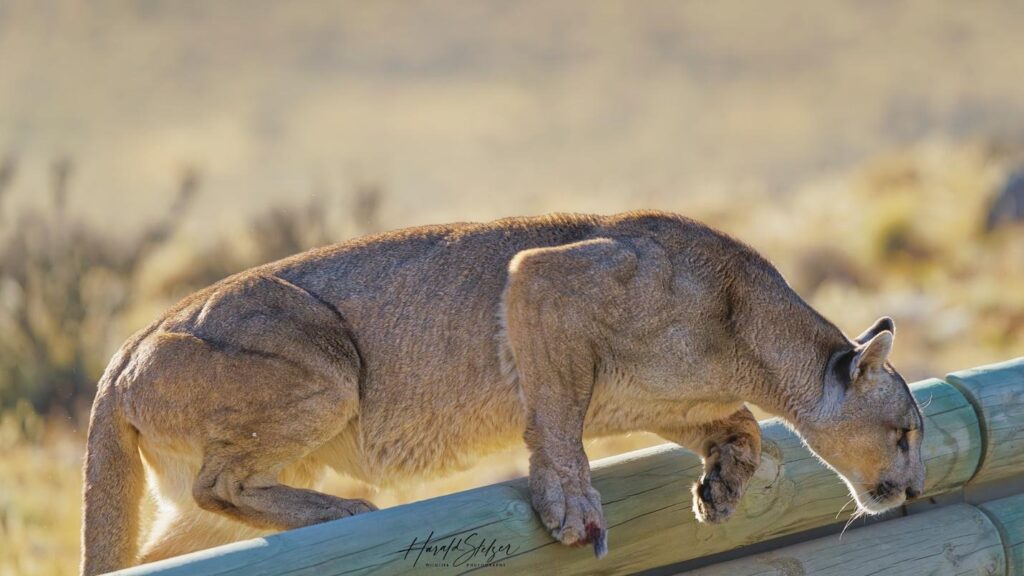
Petaca jumping the guardrails after the busses and cars have all gone, crossing the road, for a hunt that ended before it ever had a chance.
* Funded by the European Union. Views and opinions expressed are however those of the author(s) only and do not necessarily reflect those of the European Union or HORIZON-MSCA-2023-Staff Exchanges JUSTLA – Justice in the XXI Century: A Perspective from Latin America, Grant Agreement: 101183054. Neither the European Union nor the granting authority can be held responsible for them.
* Este texto não reflete necessariamente as opiniões do Boletim Lua Nova ou do CEDEC. Gosta do nosso trabalho? Apoie o Boletim Lua Nova!
Fonte imagética: Acervo pessoal do autor. The guanacos, the primary prey of the pumas in Torres del Paine, with the granite towers in the background. Guanacos are the alarm system for puma trackers – their behaviour often reveals the presence of a cat before any direct sighting.
References
BELICIA, T. X. Y.; ISLAM, M. S. Towards a decommodified wildlife tourism: Why market environmentalism is not enough for conservation. Conservation and Society, v. 16, n. 4, p. 1–13, 2018.
CARLOS, N.; GARCÍA LONDOÑO, A. F. Revisión bibliográfica sistemática del impacto del turismo en el bienestar de la fauna silvestre en Sudamérica. El Periplo Sustentable, v. 46, p. 30–55, 2023. https://doi.org/10.36677/elperiplo.v0i46.21010
CHALCOBSKY, B. A.; CRESPO, E. A.; COSCARELLA, M. A. Whale-watching in Patagonia: What regulation scheme should be implemented when the socio-ecological system is changing? Marine Policy, v. 75, p. 165–173, 2016. https://doi.org/10.1016/j.marpol.2016.11.010
CHILE NATIVO. Puma tracking in Torres del Paine: Following the footsteps of Patagonia’s great feline, 2026. https://chilenativo.travel/current-events/puma-tracking-in-torres-del-paine/
COOPER, E. J. Wildlife photography: Ecological tool or invasive practice? A study of wildlife photography and its practitioners. Master’s thesis — Queen’s University, 2017.
DANS, S. L. et al. Effects of tour boats on dolphin activity examined with sensitivity analysis of Markov chains. Conservation Biology, v. 26, n. 4, p. 708–716, 2012. https://doi.org/10.1111/j.1523-1739.2012.01844.x
ECOCAMP PATAGONIA. Tracking pumas in a puma’s paradise: Torres del Paine National Park, 2025. https://www.ecocamp.travel/blog/tracking-pumas-in-torres-del-paine
ELBROCH, L. M. et al. An initial genetic assessment of the emblematic pumas of the Torres del Paine UNESCO Biosphere Reserve. Diversity, v. 16, n. 9, art. 581, 2024. https://doi.org/10.3390/d16090581
ILUSTRE MUNICIPALIDAD DE TORRES DEL PAINE, PANTHERA, THE NATURE CONSERVANCY, TORRES DEL PAINE LEGACY FUND & SERNATUR, 2025. Protocol for Responsible Puma Viewing in the Torres del Paine Biosphere Reserve of the Torres del Paine Municipality. 39 pp.FAR SOUTH EXPEDITIONS. Patagonia puma tracking tours, 2025. https://farsouthexp.com/portfolio/patagonia-puma-tracking-tours/
FENNELL, D. A.; YAZDANPANAH, H. Tourism and wildlife photography codes of ethics: Developing a clearer picture. Annals of Tourism Research, v. 85, art. 103023, 2020. https://doi.org/10.1016/j.annals.2020.103023
FLASHPACKERCONNECT. Puma tracking in Torres del Paine, 2025. https://www.flashpackerconnect.com/trips/puma-tracking-in-patagonia-1-day
GUZMÁN-AGUAYO, L. et al. Temporal activity patterns of tourists and pumas Puma concolor in public areas in the Patagonia National Park, Chile. Wildlife Biology, v. 2025, n. 2, art. e01396, 2025. https://doi.org/10.1002/wlb3.01396:
MDPI. Chronic stress indicators in Magellanic penguin colonies as a function of visitor exposure [working title; see literature review on file], 2026.
MOORHOUSE, T. P. et al. The customer isn’t always right: Conservation and animal welfare implications of the increasing demand for wildlife tourism. PLOS ONE, v. 10, n. 10, art. e0138939, 2015. https://doi.org/10.1371/journal.pone.0138939
OHRENS, O. et al. Predator tourism improves tolerance for pumas, but may increase future conflict among ranchers in Chile. Biological Conservation, v. 258, art. 109150, 2021. https://doi.org/10.1016/j.biocon.2021.109150
PATAGONIAPHOTO.COM. Puma photography tours, 2025. https://patagoniaphoto.com/our-photo-tours/pumas
TORTATO, F. R.; HOOGESTEIJN, R.; ELBROCH, L. M. Have natural disasters created opportunities to initiate big cat tourism in South America? Biotropica, v. 52, n. 3, p. 409–413, 2020. https://doi.org/10.1111/btp.12777
WILD IMAGES. Chile: Walking with pumas — photography tour, 2025. https://www.wildimages-phototours.com/photography-tours/puma-chile-torres-del-paine/
- Senior scientist at the Institute of Philosophy at the University of Graz. He is a member of the Field of Excellence Climate Change Graz at the University of Graz, where he has been working as research manager from 2019 to 2024. Previously, Harald was Professor of Political Philosophy at the Institute of Philosophy at the University of Graz (2014-2019). His research focuses on the development of criteria that can be used for the normative assessment of technologies and climate change pathways. An important background in this context is the question of the extent to which technical solutions can provide an adequate answer to sustainability problems. An extension of his research is the question of the changing relationship between humans and nature, which plays a decisive role in social transformation processes. ↩︎